
Before the A1+ TV channel was shut down, President Robert Kocharyan announced that he “loved A1+ a lot.” But he immediately added that if A1+ were shut down he would invent a new one. Two days after Kocharyan’s statement, HHHM made the decision to shut down the TV channel. Over six years have passed since that, but a new A1+ was not invented. Instead we have over a dozen new, responsible TV stations.
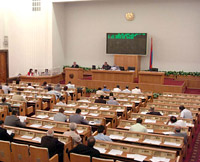
At present, RFE/RL is virtually facing the threat of being shut down, however Kocharyan has fortunately not spoken about his “love” for Radio Liberty. However, last week, foreign minister, Vardan Oskanyan made a few touchy statements about Liberty. He said that he’s really sorry for it, and said that he doesn’t even imagine that RFE/RL could be shut down. And if considering the fact that A1+ was shut down two days after Kocharyan’s confession of love, then we must assume nothing good about Liberty. This is emphasized by the fact that Oskanyan’s name is closely associated amongst the future candidates of the presidential elections. It turns out that Oskanyan is not that original with his agony, as such words could be heard in different corners of the National Assembly. However, the authors of those words of pity were those deputies who voted for the bill at the first reading and were impatiently waiting when it would be ready for the second reading so that they could vote for it once again. While the deputies were asking each other whether Liberty would really be shut down, the newly appointed Justice Minister, Gevorg Danielyan, confirmed that if these bills are voted for, Liberty will really be shut down. “A legal ban on retransmission of foreign broadcasts by Armenia’s widely accessible state radio could extend to the daily news programs of RFE/RL’s Armenian service,” Danielyan said. Danielyan made this clear as parliament wrapped up heated debates on a package of government-drafted amendments to the Armenian laws on broadcasting and state dues that are widely regarded as an attempt to severely restrict RFE/RL broadcasts. The National Assembly passed the draft amendments in the first reading on Friday, and is expected to turn them into law on Tuesday. The National Assembly continued the extraordinary session, which is discussing the amendments to the laws on television and radio and state dues. The amendments are a package because they refer to the same problem, TV and radio broadcasting. In particular, some say the amendments are aimed to bar the broadcasting of Radio Liberty because the amendments to the law on television and radio bar foreign broadcasters from public television and radio. The amendments to the law on state levies set down a 70 thousand dram state levy for each program broadcast on private channels. Last week the first reading of the amendments was held. During the second reading on July 2 the amendments were modified. Namely, in the law on television and radio, the notion of broadcaster is defined as a company which has the right to broadcast on television or radio. The members of parliament wondered what the new definition means and if it refers to Radio Liberty, in other words, if Liberty is a broadcasting company which is not allowed to use the frequency of the public radio. Justice Minister Gevorg Danielyan said that while the new definition “may refer to Liberty”, it depends on the status of the radio station. “With regard to broadcasting, it may refer, but with regard to production, it does not refer. If it is going to be production and materials, which are provided to a company, there is no restriction. In addition, there is no restriction independent from the status of the television and radio company. If it refers to broadcasting, when the frequency is provided to another broadcaster, it will refer by all means,” Danielyan says. The amendment to the law on state levy was also modified. The seventy thousand drams presented during the first reading that the private company must pay to the government to provide its frequency to another broadcaster was reduced to 60 thousand drams. The parliament’s tiny opposition minority, meanwhile, again accused Kocharyan and his three-party governing coalition of seeking to muzzle what it again called the sole broadcaster not controlled by the authorities. “It is evident that Armenia’s political leadership has decided to close down Radio Liberty,” charged Victor Dallakyan, a veteran parliamentarian opposed to the government. “The freedom of the rank-and-file citizens of our country is under attack,” said Anahit Bakhshyan, of the opposition Heritage party. Yesterday there were also recommendations to discuss the voting of certain bills before September, and even if adopted those won’t be endorsed for a year, so that people wouldn’t think that the law is being adopted on the threshold of Presidential elections. “Since 1990 the USA has donated over 3 billion USD to Armenia. The support showed by the RFE/RL is humanitarian… If you are refusing the support for Radio Liberty you must refuse the overall help of the US,” Dallakyan told the government. Bakhshyan said that all the deputies who will vote for this bill don’t like Radio Liberty. In order to know to what extent the deputies like RFE/RL will be found out today after the voting.