
After intense “discussions”, the newly formed National Assembly endorsed the plan presented by the government with 94 “for”, 7 “against” and 9 “neutral” on Wednesday.
The “constructive” oppositional “Heritage” faction voted “against”, while “Legal State” and independent deputy Victor Dallakyan voted “neutral”. The government plan, which was presented by Prime Minister and chairman of the Republican Party board Serge Sargsyan, includes formulations that are simply ridiculous. It turns out that the government has decided not to tolerate corruption, favoritism, shadiness and such things (even among their colleagues, friends/relatives and partisans).
“Corruption and not paying taxes must be observed as dishonorable, publicly condemnable phenomena. We can’t be forgiving, and must start with ourselves,” said RA Prime Minister and chairman of the Republican Party board Serge Sargsyan, who recently also said: “We must not take into consideration friendly ties and not consider people who are not going to pay taxes and who are going to tolerate this fallacious phenomenon as our friends or partisans.”
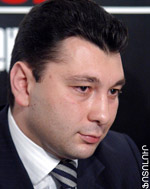
It seems as though all is well-said. But if we take a look at, say, the Republican Party board members, a lot of questions arise. For example, how should certain people of that board not tolerate corruption, starting with themselves? How should those people fight against corruption, much less, start with themselves…? This is as ridiculous as the fact that the deputies in the standing committee on human rights protection are people who simply don’t comply with that concept. Interestingly, do the many Republican businessmen and oligarchs honestly pay their taxes so as not to tolerate the corrupt? It turns out that there are no oligarchs within the Republican Party. At least, that is what deputy of the Republican faction, Edward Sharmazanov, announced at the “Friday” club on Wednesday. In fact, when we say the word “oligarch”, we understand the following: a businessman who is obedient in politics and goes unpunished in economy. As far as Republican businessmen paying taxes is concerned, the Republican representative said that their party is the only existing party in the legislative field and “obviously, each citizen who has certain political biases and accepts the Republican Party’s platforms may become a member of the party regardless of whether he is unemployed or someone who has earned what he has earned through hard work.”
However, is Sharmazanov sure that all of his partisan businessmen honestly pay their taxes?
“It is a fact that there is a shadow economy in Armenia. I hope that the fight against the shadow economy will be even more productive in 2007-2012. The presence of this is not only conditioned by the authorities or given businessmen,” said the speaker.
After a short while, responding to another similar question, Sharmazanov said that the Republican Party obviously “doesn’t prefer people (including people in his party) who will violate the law or disrespect the law and civil society.” It turns out that according to Sharmazanov, there are no Republican outlaws, everyone “respects the civil society” because the outlaws are “not preferable” for the Republicans. Sharmazanov proposes to go by the facts. According to him, “the Republican Party is a team of ideological activists and not a team of individuals.”
However, let’s get back to the government plan. It is stated that the fight against corruption, the shadow economy, and unequal competition conditions are in the field of inefficient management. What was holding the Republican Party back from efficiently managing that “fight” during the previous years? Sharmazanov gave the following response to that on Wednesday:
“In 1999, when Vazgen Sargsyan turned prime minister, there were many unsolved issues and the Republican Party implemented the first generation of reforms, which was to create the legal, political and economic foundations of the state. There is no field, starting from corruption, where the joint activities of the president and the Republican Party did not lead to positive reforms. We have reached certain positive reforms, and with this second generation of reforms, we wish to strengthen the first. If there have been mistakes, we have corrected those mistakes as well.”
How does the Republican deputy evaluate the atmosphere in which the “discussion” of the government plan took place recently at the National Assembly? According to him, the “atmosphere was rather normal, heated (active), and the discussions were normal.”
“The parliament is made to have a clash of people and their opinions,” explained the deputy. Of course, it is preferable to not have “people clash”, but that wouldn’t be very surprising in this parliament. But the fact that the “Legal State” faction made positive remarks regarding the government plan and voted “neutral” instills hope in Sharmazanov that this parliament will be nothing more, nothing less than a “parliament of ideas” and every bill will be seriously discussed. All that is left to do is wait impatiently until the National Assembly fall session, so that we can witness the “heated-up discussions” in the “parliament of ideas” before the Armenian presidential elections. In short, fall is ahead and it is going to be hot.