
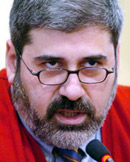
Yesterday Kiro Manoyan, the chief spokesman for Dashnaktsutyun’s worldwide ruling Bureau, literally said the following, “Azerbaijan had better understand that the negotiations cannot continue for very long. We are not afraid of their threats either. We are not that crazy to wait for Azerbaijan to start a war. When we see that’s the solution, we’ll be the first to start.” The Armenian Revolutionary Federation is against the return of any of the liberated Azerbaijani territories around Nagorno-Karabakh. Manoyan believes that they should repopulated by Armenians instead. “We are against ceding the liberated territories. We are against giving away any territory,” said Manoyan. “The notion that Karabakh must be connected with Armenia only through a single corridor is unacceptable to us,” he added in a clear reference to international mediators’ existing peace plan on Karabakh. The plan calls for the return of at least six of the occupied districts before the holding of a referendum of self-determination in Karabakh. Armenia’s leadership has largely accepted this peace formula. Dashnaktsutyun leaders have never publicly rejected this stance or threatened to quit the governing coalition, in which their party is a junior partner.
It turns out that the ARF is not being half-pregnant only regarding the formation of the government. The party has adopted a similar approach regarding the resolution of the Karabakh conflict. During his press conference at Pastark Club, Kiro Manoyan, the chief spokesman for Dashnaktsutyun’s worldwide ruling Bureau, announced several times that the ARF “is against ceding any of the liberated territories to Azerbaijan.”
Head of the Armenian Revolutionary Federation (Dashnaksutyun) Armenian office, Kiro Manoyan, is sure that the Nagorno Karabakh conflict settlement will again be prolonged for an indefinite time. Manoyan told a press conference today “There are serious reasons for that,” and named the presidential elections in Azerbaijan, Armenia, Russia and USA as the reasons. “Presidents may meet but no progress will be reported,” Manoyan said. The Dashnak leader also reiterated that Dashnaksutyun is against handing over “any territory.” He also said the liberated areas must be inhabited. However, the Dashnak did not say where that money might be found in case the government has a program of action. The Armenian Revolutionary Federation (Dashnaktsutyun) is against the return of any of the liberated territories around Nagorno-Karabakh and believes that they should repopulated by Armenians instead, a representative of the governing party said on June 25. “We are against ceding the liberated territories. We are against giving away any territory,” Manoyan said of the seven Armenian-occupied districts in Azerbaijan proper. “The notion that Karabakh must be connected with Armenia through a single corridor is unacceptable to us,” he added in a clear reference to international mediators’ existing peace plan on Karabakh. The plan calls for the return of at least six of the occupied districts before the holding of a referendum of self-determination in Karabakh. Armenia’s leadership has largely accepted this peace formula. Dashnaktsutyun leaders have never publicly rejected this stance or threatened to quit the governing coalition, in which their party is a junior partner. Manoyan would not specify what the nationalist party will do if the authorities in Yerevan press ahead with the proposed settlement. Blaming Azerbaijan for the collapse of the latest round of peace talks, he said instead that Yerevan should stop even talking about territorial concessions to Baku. “Given Azerbaijan’s position during the entire negotiating process, we no longer have reason to make such statements, even if they cast us in a positive light,” Manoyan told a news conference. “Because if you say the same thing many times you will eventually start believing it. So it would be good to put an end to those statements and put the emphasis on resettlement. It is important to instill in the people the notion that repopulated territories can not be given back. That is why the resettlement must start quickly,” he said. Manoyan also made the point that the Karabakh dispute will likely remain unresolved in the foreseeable future and that Armenia should therefore eventually formally recognize Karabakh’s secession from Azerbaijan. “If negotiations yield no results in two, three, five or ten years … it is clear that Armenia should either recognize Karabakh’s independence or annex it,” he said. “There is no other option.” The speaker insisted on the prognoses made as far back as a year ago, i.e. the regional developments and the geopolitical situation in the Near East as well as the superpowers’ concerns in connections with Turkey-Iran relations do not make it possible to anticipate significant or essential progress in the Artsakh settlement process. Manoyan substantiated his viewpoint in the following manner: “Being interested parties, the mediators are now occupied with other problems, and Artsakh is not a priority for them. The countries representing the Minsk Group are now resolving other conflicts. The Artsakh issue is not of key importance, especially considering that the cease-fire has been quite stable without peacekeeping forces for more than 13 years now. This is the reason the talk of having peacekeepers does not increase pressure on the conflicting parties to settle.” The guest speaker of the club attached particular importance to the attitudes of the conflicting parties in the current situation: “The outcomes of the talks depend on that; whereas Azerbaijan has stuck to an attitude of refusing these arrangements. This was what happened during the last meeting between the Armenian and Azeri Presidents in St. Petersburg. So, there are no grounds to expect the negotiating parties to make specific progress in the near future.” There are also other impulses not allowing any progress in the talks till the end of 2008 or even in 2009. They are the presidential elections to be held in Armenia, Azerbaijan, the Russian Federation, and then in the United States, in addition to the Parliamentary and presidential elections to be held in Turkey. To have the groundwork for solving the Karabakh issue in favor of the Armenian side, Manoyan emphasized several requirements: “The only thing we can do during the coming two years is to stimulate the repopulating programs and then liven up the diplomacy on all levels, including the state, Parliamentary and public levels.”