
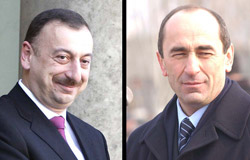
On June 9, in Saint Petersburg, Armenia registered another diplomatic victory. As informed by certain extremely free, yet a bit less responsible Armenian media representatives right after Kocharyan-Aliyev meeting, Kocharyan’s smile was wider than Aliyev’s. Moreover, according to certain estimations, right after the meeting Aliyev appeared in deep depression. This long expected meeting didn’t give any results, as usual, and this time again Kocharyan and Aliyev succeeded in “swindling” the international community or at least the co-chairs of the Minsk Group, after the recent visits of whom Armenia has become an “island of optimism” for the region.
As it was expected, the Kocharyan-Aliev meeting in Saint Petersburg on June 9 did not result in anything positive. There isn’t much information about the mentioned meeting, which lasted over three hours, but all that is available is quite enough to stress that there wasn’t any achievement in the process of the Karabakh conflict negotiations during the meeting.
Following the bilateral meeting of Aliev and Kocharyan, a discussion was organized with participation of the presidents, foreign affairs ministers and OSCE mediators, which lasted one hour. Neither Kocharyan nor Aliev made any announcements after the meeting. Neither did the OSCE mediators inform any details after the meeting. However, yesterday the French co-chair of the OSCE MG, Bernard Fasier, made several announcements that had been heard before too. He said that new ways of the Karabakh conflict settlement had been presented to Kocharyan and Aliev, and that the negotiations will continue. By refering to “trusted sources of information” Azatutyun radio station informs that Kocharyan and Aliev failed to come to an agreement on several main issues, the most important of which is the issue of Karabakh’s status. The Azeri party insisted on excluding any points concerning Karabakh’s status from the interim agreement, but the Armenian party insisted on including in the agreement the mechanisms, according to which a referendum shall be organized in Karabakh, and also define the “method, according to which Karabakh’s status shall be defined”. Certainly, it is very strange that no agreement has been reached upon the ways of defining Karabakh’s status so far, and if there hasn’t been such an agreement, we wonder what referendum Kocharyan meant when insisting on his stance. Notwithstanding, Armenian FM Vardan Oskanyan said that “deep discussion was held during the meeting”. “There was no significant improvement in Petersburg. Even though the difficulties still exist, the first negotiation of this year between the presidents was deep, and a serious discussion was held concerning the main principles, which helped to clarify some certain issues,” said Oskanyan. He also said that no agreement was reached upon the issues that were controversial. Answering to notes concerning the possibility of re-starting the process from ground zero in case of failure to reach agreement by the end of this year, Vardan Oskanyan said that he was against drastic approaches. He says that negotiations represented by the foreign affairs ministers will continue, and that it is hard to say when the next meeting of the presidents may take place. As for Azerbaijan, the Azeri FM said that things didn’t change during the meeting of the presidents. Mamediarov said that even though there was no significant improvement during the meeting, best efforts were being taken to keep peace in the region. “The parties spoke their stances, but I can’t say that there is any improvement in that term. There are new components, which I can’t say are that new. The main principles were discussed, based on which we are going to reach an agreement to make long-term peace in the region,” said the Azeri FM. Furthermore, Oskanyan added that “there are disagreements in term of the presidents’ negotiations, but there is an opportunity to continue the negotiations”.
By the way, this time the coverage of information concerning the meeting of Aliev and Kocharyan is very interesting. For instance, National TV, which was accompanying Kocharyan, recommended to the viewers to make their own conclusions basing on the appearance of Kocharyan’s and Aliev’s faces and “stressed” that Kocharyan’s mood was better than Aliev’s. Besides that, it turns out that Kocharyan was the first to visit the meeting place, where he had greeted the participants and journalists. Instead, National TV reported that Aliev arrived at the place later and was in a bad mood, so much that he didn’t even see the Azeri journalists there. As you see, this is one of the “overwhelming proofs” about the excellent achivements of our diplomacy. However, Azeri political scientist Vafa Guluzadze discussed the presidents’ meeting and said that “it was a meeting for the sake of meeting”. According to him, “Russia has frozen the process, and the U.S. is occupied in other issues, such as the missile defense issue, and the issue of Karabakh is not a priority issue for their policy.” Armenian political scientist Levon Melik-Shahnazaryan thinks that Karabakh is one of the rare conflicts where there aren’t very many sharp disagreements between the parties. He thinks that the OSCE MG co-chairs agree that there must not be a new war. However, he thinks the interests of the parties in that framework are different; the U.S. wants to keep an eye on the oil resources of the region, Europe wants to make sure that the oil and natural gas reaches its economy in secure conditions, and Russia wants to keep its influence both in Armenia and in Azerbaijan. The Armenian political scientist also believes that there will not be a war before 2025. He thinks that the “complementary” policy implemented by Armenia does not have an alternative.
P.S. The head of the foreign affairs department of the Azeri president’s office, Navruz Mamedov, presented the Kocharyan-Aliev meeting in Saint Petersburg on May 9 as “hard”. He also said that “Azerbaijan’s stance would be toughened in regard to Armenia, the OSCE mediators, and the international community, and thus demand from them to make their stance more specific concerning the Karabakh conflict issue. Despite the fact that Azerbaijan’s reputation in the region is growing, it was not enough for Armenia to present a constructive approach during the negotiations.” Mamedov also said, “If the international community does not specify a certain stance and does not come up with recommendations, there may be an issue of war.” He said that the parties had agreed to continue the negotiations represented by the foreign affairs ministers (the Armenian foreign affairs minister said this as well). However, Vardan Oskanyan did not inform whether he thought there would be one more Kocharyan-Aliev meeting by the end of this year or not.