
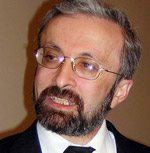
Yesterday at Tesaket club NA chairman Tigran Torosyan, referring to the evaluations of the European monitors about the 2007 parliamentary elections in Armenia, said that those proceeded in accordance with international criteria.
Torosyan spelled out the approach of the Republican Party, which is the parliament majority according to the result of the voting, towards the forming of the new government. “The steps should be made one after another, in accordance with the logic of political relations,” stated Torosyan in response to reporters’ questions. He almost uttered nothing definite, except for the appointment of two ministers, the ministries of defense and foreign affairs. Torosyan declined to say who will be appointed to these posts. He said who will do the appointing. “Two ministers are appointed by the head of state, so why should the head of state give these posts to anyone else, any party?” Torosyan says. According to him, a minister can be a member of a party, but since these spheres are special for the president, naturally the president will choose whom to appoint to these posts. “I do not think he will propose any party to appoint these posts. This would not serve logic,” says the deputy leader of the Republican Party. In answer to the question of if it is possible that the minister is partisan but the portfolio is not, Torosyan said generally it is possible, but in the case of the new government it is ruled out. As to the questions on other portfolios, Torosyan answered that everything will be decided in negotiations, which will be conducted with a wide range of political forces. “There are lots of opportunities for collaboration; what matters most is comprehensive cooperation. On the other hand, the more parties that collaborate, the more pluralism and the more effectiveness. Although I think the Republicans are always ready to collaborate, independent from the format of collaboration, participants, the number of participants, etc.,” Torosyan says. For instance, he says in 1999-2003 there was no coalition, but there was comprehensive collaboration with Dashnaktsutyun. In answer to the question of whether there are ministries which will definitely be appointed by the Republican Party, Torosyan said: “I understand that you want to discuss the formation of government here. It is a good wish but it will not come true.” In fact, the speaker of the National Assembly did not answer this question. He also declined to answer the question of if he wishes to remain speaker of the National Assembly. Clearly referring to the Armenian ministries of defense and foreign affairs, Torosyan, the outgoing parliament speaker and the HHK deputy chairman, said: “There are two ministries whose heads are effectively chosen by the president of the republic. So why would the president of the republic gives those posts to any party?” One of the Dashnaktsutyun leaders, Armen Rustamyan, said on May 9 that the Defense Ministry must no longer be run by “those who do not represent a political force or a party.” “We must put an end to this,” he told a campaign rally in Yerevan. Torosyan insisted, however, that President Robert Kocharyan must continue to directly control the Defense Ministry. “I don’t think he has to offer any party to nominate people here and there,” he said. Like other top Republicans, Torosyan made it clear that the RPA does not want to form a classical coalition government as a result of the elections, but is ready to give high-level government posts to other parties loyal to Kocharyan. “The most important thing is to have full-fledged cooperation,” he told a news conference. “The more parties involved in that cooperation, the more pluralism there will be.”