
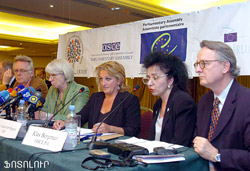
Modestly said, what the Armenian citizens saw on the May 12 election day doesn’t have anything in common with what the international monitors saw. It turns out that hundreds of international monitors, who been deployed in Armenia’s precincts, didn’t notice any serious violations. They only noticed some “not dangerous” shortcomings, which didn’t affect the results of the election.
For example, they didn’t notice the hundreds of Gazels (vans), which were occupied with transporting people to precincts. They didn’t notice the electoral bribery taking place not far from the precincts. Instead they noticed some monitor things such as somebody trying to vote with a red passport, which turned out to be only the plastic red cover of the actual RA passport. The observers of the OSCE Office for Democratic Institutions and Human Rights (ODIHR), the OSCE Parliamentary Assembly, PACE, and the European Parliament issued a formal statement on the Armenian parliamentary election on May 13, which produced a dual impression. During the press conference, the observers commended and congratulated the Armenian people for the progress in the election. The observers say the Armenian election was compliant with norms and there was considerable progress compared with the elections of the past eight years. The elections demonstrated improvement from previous ones, and were largely in accordance with international commitments, although some issues remain unaddressed, runs the statement of the observers. According to the coordinator of the observers Tony Tingsgaard, the Armenian election and the campaign complied with the legislation, which is good for the young Armenian democracy. The observers were especially excited about the day of voting. The election day was calm, they said. The voting was assessed as good at most polling stations they visited, in 94 percent of polling stations. The observers say a few cases of fraud were observed but those were not enough to essentially affect the conduct or results. For instance, the voters did not observe election bribes, and it is difficult to report without observing, whereas they report what they observe, which is all that is possible to prove later.
In the parliamentary election of 2007, unexpectedly, the Armenian society was amazed by the international observers, not the participants of the home political process. People were not amazed that the government used every method to hold on to power, to justify its viability; it was not a surprise that the CIS observers gave a positive evaluation to all this. The last “hope” was the Western observers, who were supposed to be unbiased in their evaluations. Let us forget for a moment what the international observers said and why, and imagine what would happen if they said what the Armenian society, or at least its activists, had longed to hear, and who were disappointed with the evaluation of the observers.
Now let us imagine: Yerevan, May 13, Zvartnots Airport. The international observers hurry to the airport with their suitcases. A big crowd of reporters, representatives of NGOs, opposition activists, as well as a migrant worker whose suitcase the coordinator of the observation mission took by mistake are running after them. The crowd shouts: “Give your evaluation!” “Give me my suitcase!” shouts the migrant worker, whose voice is not heard in the noise. The observers continue to run without looking behind them. The crowd continues to chase them and shouts: “At least the first word, we will guess the rest.” “At least give me what is in my suitcase,” shouts the migrant worker. The observers hardly get on the plane, and before locking the door they slip an A4 paper out to the crowd, on which is written: “This is not a country, this is not a democracy, run away to save yourself.” While the crowd is reading the paper, the plane is already flying above Georgia, and the reporters, representatives of NGOs, and opposition activists do not manage to thank the observers for the unbiased evaluation. Everyone returns from the airport to Yerevan. Now imagine what these people are doing in Yerevan. Is it difficult? Of course, it is. “What did you think? Did you think it would be easy?” said actor Khoren Abrahamyan to the Armenians in the years of the energy crisis, before leaving to work in the United States. At that time it was difficult to live, and now it is difficult to imagine what the civil society of Armenia can do when the international observers have given an unbiased evaluation – i.e. the results of the election were falsified. To imagine this first, we need to imagine what the opposition can do in this country. We all know what the government can do and we need not imagine. The government does things which become reality before one manages to imagine. Meanwhile, the opposition and the “authorized representatives” of the civil society expect the international observers to be unbiased. And only they know why they need an unbiased evaluation. Perhaps this evaluation is viewed as an approval of a revolution. In other words, the world gets angry with the government and tells the opposition: “Enough, go and get the power. It’s yours.” They go and see that the government gives nothing. “But they wouldn’t give,” the opposition says, turning to the observers in distress. “Excuse us, but we did what we were supposed to, we gave an evaluation, the unbiased one, do you remember, at the airport?” the observers will say. Here’s a deadlock. What to do? It seems there is everything needed for a revolution but nothing happens. It is necessary to think, and in order to think a cafe, better a terrace, is needed for the public to see how the opposition is working, gathering information, classifying by importance and leaving the unnecessary information to the waiter for a tip.
P.S. President Robert Kocharyan congratulated Armenians Monday on his administration’s conduct of the weekend parliamentary elections, saying that they were free and fair and marked “another major step towards democracy.” “The elections were free, fair, and transparent, which is certified by the Central Election Commission, law-enforcement bodies, as well as local and international observers,” he said in a written address to the nation. “I congratulate all of us on taking yet another step towards democracy.” Kocharyan said authorities will “meticulously examine” and redress all irregularities reported during the vote. He also urged election contenders to end election-related recriminations and “restore the atmosphere of mutual tolerance” now that the official vote results have been announced. According to the Central Election Commission (CEC), the Republican Party (HHK) of Prime Minister Serge Sarkisyan won about 34 percent of the vote and will control nearly half of the 131 seats in the National Assembly. The Prosperous Armenia Party (BHK) of Kocharyan-connected tycoon Gagik Tsarukyan came in a distant second, followed by another major pro-presidential party, the Armenian Revolutionary Federation.