
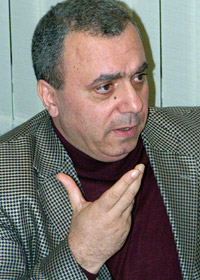
– Mr. Bagratyan, why isn’t “Azatutyun” party running for the parliamentary elections?
– In consideration of the fact that there is lack of resources, the best option to participate in the elections as opposition was uniting and making a common opposition. Notwithstanding, it didn’t happen. The opposition is participating in the elections being four times more divided than the authorities are. In this case, to participate in the elections would mean to divide the opposition’s votes even more. In order to escape any possible criticism, it is worth mentioning that we agreed with all the parties that applied to us to unite. We were ready to run in any format. We neither asked about the lists, nor for any spot on the lists. It is a pity that among the opposition leaders, there are many people that believe the voters are dreaming about them.
– What do you think about the pre-election campaign?
– I have already said that the authorities will win these elections easier than in 2003. Firstly, the governmental parties (ARP, ARF and PA) are less divided than the opposition (it consists of over 10 parties). Secondly, there is an innovation this time, which is the fact that the opposition has become the largest employer. We are periodically monitoring the economic field to figure out the level of economy centralization. Currently a family in Armenia possesses 8% of the GDP, two families – 12%, 10 families – 16% and 44 families – 5%, respectively. With its level of wealth centralization, Armenia exceeds Ukraine (by 3.3 times), Russia (5.4 times) and the U.S. (16 times). Do you understand that it will be very difficult to counterbalance these 44 families if they agree to distribute the power? The free sector of the economy covers only 45%, 26% of which are the fields of agriculture, trade and small services, 15% being Russian capital, and 4% other capital, which consists of mainly western capital. This means that the authorities are influencing the voters not only with the help of their administrative tools (army, government, state resources, army, etc.), but also as a big employer. In other words, there is a new tendency, which is that the employees are electing the employers. This process tends to be growing, and in several years, at the least, there will be no need for voter bribes any more.
– But the fact is that in all the countries employees elect their employers in certain ways.
– That’s true. But in this case there are two different factors. To note, almost all the employers also have political influence (presidential, plus governmental and parliamentarian). Everywhere, wealth is interconnected with politics. Also, the level of centralization is too high here. We have several dozen employers, instead of several thousand. If this process continues several more years, we will have a system of inheriting power. If this process continues more than four years, we’d be better to amend the Constitution to make the political system one of “inheritance” than continue with the institution of elections.
– Why are the ARP and PA the first ones among the governmental powers? Do you think they are the biggest employers?
– Actually, they are. However, the other governmental parties, the ARF and the ULP, are big employers too. However, there is a small difference here. The employers of the ARP are not as consolidated as the employers of PA. The latter has a strong charismatic leader. In this framework, I think that the creation of PA was one of the most successful projects of these authorities.
– As an economist, what would you say about the economic programs of the political parties that are running?
– I have managed to read almost all the projects that have been issued so far. It is worth mentioning that almost all the projects have better qualities than the previous ones. However, the political parties that have been participating in state management during recent years have benefited much. Certainly, it is clear that the ARP has more opportunities in this framework. However, I think the opposition has very serious economic programs too.
– Don’t you think that populism is preventing many things?
– Certainly, it is impossible to escape from it. We have heard many promises about increasing salaries, stipends and budget income flows. Some parties are often exaggerating. For example, one of them has promised to increase the budget income for 2008 by $800mln. If they haven’t made these calculations in consideration of inflation, they should note that today in Armenia theoretically it is possible to collect only 24% of the GDP in the budget. In consideration of the existing tax legislation and wages, this is the maximum limit that tax collection can provide. This means that the maximum they can increase the budget income flows by is $480mln within one year (not counting currency exchange rate changes and inflation factors). Besides that, some of them are speaking about increasing the stipends up to 30-40 thousand dram. They are lying. They have to collect a sum equal to the annual budget to pay such a stipend, which adds up to about AMD300bln. It is impossible. In addition, now the citizens that were born in the period following WWII are entering their stipend age. In that period the birth rate was high. If the increase of stipend rates covers inflation and higher prices, it will be very good. Instead of speaking that absurdly they’d better speak about creating a private stipend system, which would enable the citizens to decide how much stipend they want to get in the future.
– What are your party members and what are you going to do as voters?
– Being out of the direct campaign I will do my best to support the political powers that I advocate. I am advocating the political powers that have serious and good reform programs. Some of those parties are the ANM, “Republic Party” and “Impeachment” bloc. The oppositional appearance of these parties is a guarantee for an alternative in Armenia. Two or three other parties may join them too. As for our party, I think that our party members will make a decision later.