
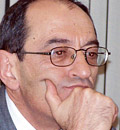
It seems as though the Armenian opposition is in shock after May 12, and there are still no signs of recovery. Why did the opposition find itself in such a situation and what should it do to get out of that situation? We interviewed leader of the National Democratic Party (NDP), Shavarsh Kocharyan, for the answers to these questions and more.
– Mr. Kocharyan, it looks as though a considerable part of the political figures who considered themselves oppositional disappeared after May 12. We hear nothing from Artashes Geghamyan or Arthur Baghdasaryan, Demirchyan is not on the scene, and Aram Karapetyan flew to Moscow again…Only a couple of people hold public meetings. What do you propose to get out of this desperate situation in the opposition field?
– I must speak only on behalf of our party. We already gave our evaluation, which is unchangeable, on May 13. This is not the victory of the authorities, rather the loss of the opposition. We stated the reasons for that a long time ago, after the constitutional amendment referendum of 2005. Unfortunately, the opposition did not learn from the mistakes that it had made and went to the elections separated from each other and without an ideology. The outcome was predetermined. We are in a situation when there is once again the need to reevaluate what we have done and what we haven’t done and our personal mistakes. If we don’t do that, then the situation that the opposition is currently in will deepen in a negative way.
– What do you personally expect? What should the opposition do as a result of analysis and evaluation of its mistakes that it is so stubborn not to do?
– After all, what is the goal of the political party? Many say “to come to power”. But that is a means. The most general aim is to implement certain programs. As for the opposition political party, it means to be an alternative to the existing government not because it is a good party or speaks more loudly, rather because it presents programs, approaches, and ideas that the current government is incapable of implementing. In that case, the opposition has great support from the public and in that case, the advantage that the authorities have during any election (the administrative resources) are counterbalanced by the support of the people. This is the first goal that the opposition (the collective opposition) can’t reach. After the constitutional amendment referendum in December 2005, our party made an announcement in which we said that if the parliamentary opposition did not reevaluate what it had and had not done, analyze its errors and continued to look for the guilty among people outside of the opposition, be it the authorities or international observers or the people, the reputation of the opposition would gradually fall. Unfortunately, they didn’t do that back then and the result was the opposition’s losses during these past parliamentary elections. Now we face the same problem. If the opposition doesn’t have the inner strength to evaluate all of that and continues to find guilty among those outside, then the result of the presidential elections will also be predetermined, just like the parliamentary elections.
– Numerous “experienced deputies”, including yourself, were left out of parliament this time. Some call that a “change of generation” and welcome that. In reality, is that good or bad?
– What Armenia has is a type of non-democratic system where, in the end, the opposition has a minimum impact on making decisions for the majority in parliament; the buttons do the deciding. From this aspect, the collective institute is much more fundamental. How will the National Assembly function? It has much authority with the amended Constitution, but the quality that exists (quality of the collective National Assembly), doesn’t correspond to the issues that face Armenia and the opportunities given to the parliament by the amended Constitution.
– So, there will be practically no impact on the work of the National Assembly or other things by the presence or non-presence of the “experienced deputies”.
– That impact had to be on public opinion. That impact had to be made by including different international organizations in different assemblies. The opposition was becoming weightier and from that standpoint, the loss of quality can’t have an influence.
– After the elections, your former partisan, Arshak Sadoyan, announced that he is planning to found a “school for exchange of experience” and support the change of generation in the political field. What are you going to do after your long service in parliament?
– I really don’t understand what it means to personally exchange experience after the elections. Our party is open to the youth. Sixteen percent of the deputies under our proportional system were youth. If Arshak Sadoyan has such great experience, then he should pass on that experience.
– Another one of your former partisans, Vazgen Manukyan, has already announced a couple of times that he plans on running for president during the upcoming Armenian presidential elections. Are you going to support your former partisan?
– When I was asked that question during the pre-election campaign, the question was the following: there are two people who have announced to run, and they are Serge Sargsian and Vazgen Manukyan. Whom will you support? My answer hasn’t changed, that is, if we don’t nominate our own candidate, then we will prefer Vazgen Manukyan. Now it is extremely crucial to have talks and as a result have a united oppositional candidate (it has be as united as possible). If so, and the candidate becomes Vazgen Manukyan, then it is obvious that we will back him up. However, if we have the logic that exists today where we have numerous oppositionists nominating themselves, I don’t think that we will really be able to change the situation by supporting this or that candidate, including Manukyan. Our contribution is that we will not nominate our candidate so that we don’t add to the many.
– Raffi Hovhannisian has decided to fight for his deputy mandate under the majoritarian system in the 15th precinct. Is NDP going to back him up?
– Raffi Hovannisian had to already have consulted with us and he still hasn’t done that.